
1,234.50 and 1.234,50 can represent the same amount
Published — UTC

A comma can be a decimal separator or a grouping separator. Removing punctuation before checking the number format can change an amount rather than simplify it.
Two formats, one invented value
For this example, both displays explicitly represent 1,234 units and 50 hundredths in the same currency.
| Display | Grouping separator | Decimal separator | Value |
|---|---|---|---|
| 1,234.50 | Comma | Dot | 1234.50 |
| 1.234,50 | Dot | Comma | 1234.50 |
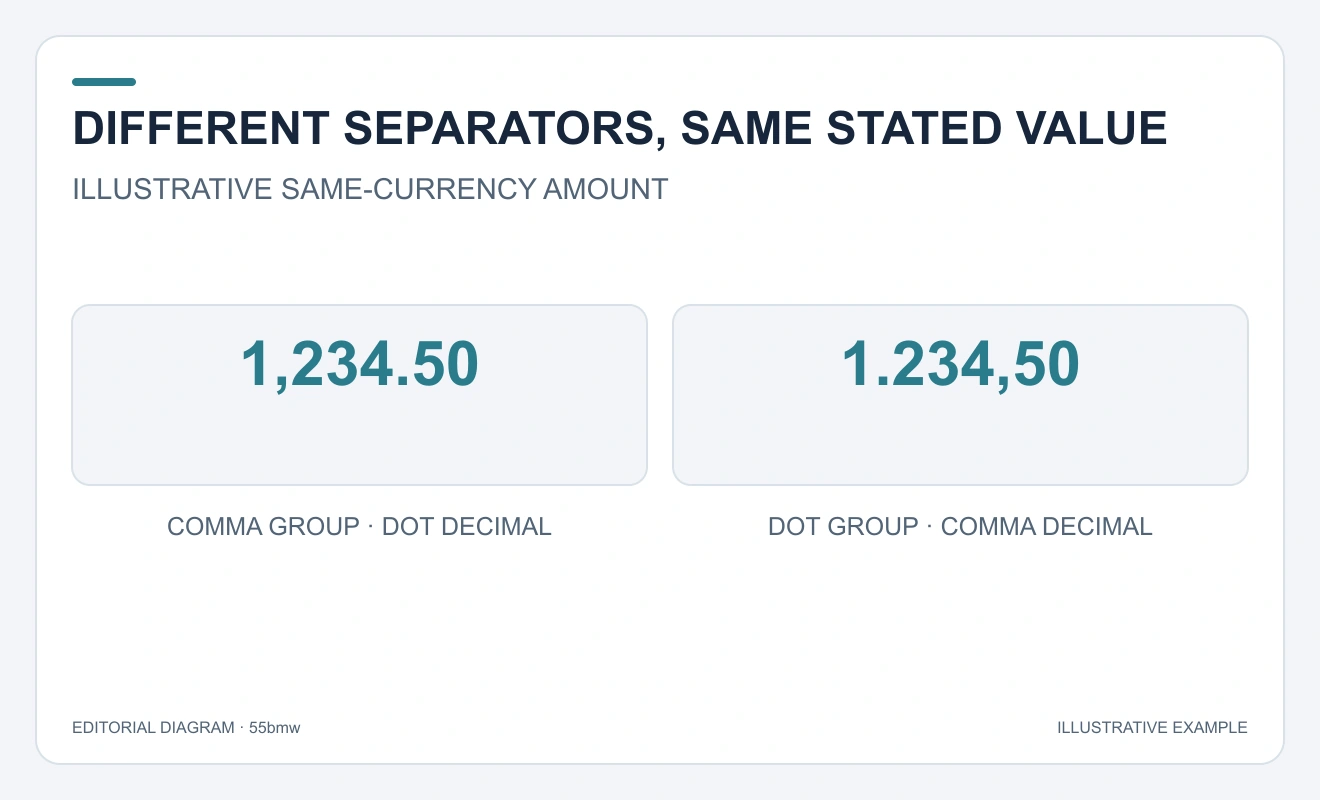
MDN’s Intl.NumberFormat reference demonstrates locale-dependent number formatting. The amount and comparison above are original; no local game’s formatting implementation is claimed.
A short label can be ambiguous
The isolated text “1,234” may mean a grouped integer or a decimal value, depending on its convention. Do not infer the convention solely from the site’s target country or a cropped screenshot. Identify the full currency label, locale setting and original machine-readable field where available.
Grouping can also use spaces, including nonbreaking spaces. Copying a formatted value into a calculator or spreadsheet may therefore need a controlled import rather than deleting every non-digit character.
Keep display and normalized value
Store the original display, its stated format, currency and normalized amount separately. If the format is unresolved, keep the amount unresolved. Do not invent a currency conversion or credit denomination to make two displays match.
Measure what punctuation removal would change
Deleting every separator from 1,234.50 produces 123450. If read as whole currency units, that is one hundred times the intended 1234.50. If an export explicitly stores integer hundredths, 123450 might instead be a valid minor-unit value. The unit definition, not the digits alone, determines which interpretation is correct.
The shorter string 1,234 has a different ambiguity: a grouping convention gives 1234, while a comma-decimal convention gives 1.234. Those values differ by a factor of one thousand. Neither interpretation can be selected safely from the isolated string without additional format evidence.
Formatting does not establish an input parser
Intl.NumberFormat renders a supplied number according to formatting options. Its formatting examples are not instructions to accept arbitrary localized text as numeric input. An import process still needs an explicit rule for allowed grouping, decimal precision, sign and unit, and should flag inputs that violate that rule.
For instance, a minus sign must survive normalization: −1,234.50 is a negative value under the first convention. Stripping every non-digit character would lose both the sign and decimal scale. Parentheses may denote a negative amount in some accounting conventions, but that meaning must be declared rather than guessed.
Check precision before comparing an export
For this example’s two-decimal currency, keep a normalized exact decimal of 1234.50 and compare it with the preserved raw text after applying the known convention. A value originally stored with three decimals may have been rounded for display; the screen cannot recover the hidden digit. Separate source precision from display precision.
Finally, record whether an amount represents currency, credits, stake, return or account balance. Two correctly parsed numbers do not represent the same quantity merely because their digits match. This process neither determines a real credit conversion nor confirms an account balance.