
Bankroll and session length: how a loss target depends on the number of spins
Published — UTC

Short answer. A longer session does not make a loss less likely. With a hypothetical ₱20 bet, a 96% return and a spread of results five times the bet, a 100-spin session has about a 2.7% chance of ending down ₱2,000 or more, a 300-spin session about 15.5%, and a 1,000-spin session about 35.2%. Each extra spin adds a small expected loss and more spread, so the chance of a large end-of-session loss rises with the length of the session. These are approximations for a hypothetical game, not figures for any real one.
The inputs, and why they are hypothetical
To estimate a session result you need three inputs: the bet per spin, the return to player (RTP) and the spread of the net result per spin. The bet and the RTP are simple. The spread is the hard part, because it depends on the game’s volatility, and a game’s published RTP does not give it. This article therefore uses a stated spread of five times the bet per spin, which is an assumption chosen to make the arithmetic visible. It is not a measured volatility for any game.
With those inputs, the expected net loss per spin is ₱20 × (1 − 0.96) = ₱0.80. Over n spins the expected loss is 0.80 × n, and the standard deviation of the total is √n × ₱100, because the per-spin spread is ₱100. A session’s end result is then approximately normal, so the chance of ending down ₱2,000 or more follows from the standard normal table.
Session results by length
| Spins | Total staked | Expected loss | Spread of total (1 s.d.) | Chance of ending down ₱2,000 or more |
|---|---|---|---|---|
| 100 | ₱2,000 | ₱80 | ₱1,000 | 2.74% |
| 300 | ₱6,000 | ₱240 | ₱1,732 | 15.48% |
| 1,000 | ₱20,000 | ₱800 | ₱3,162 | 35.22% |
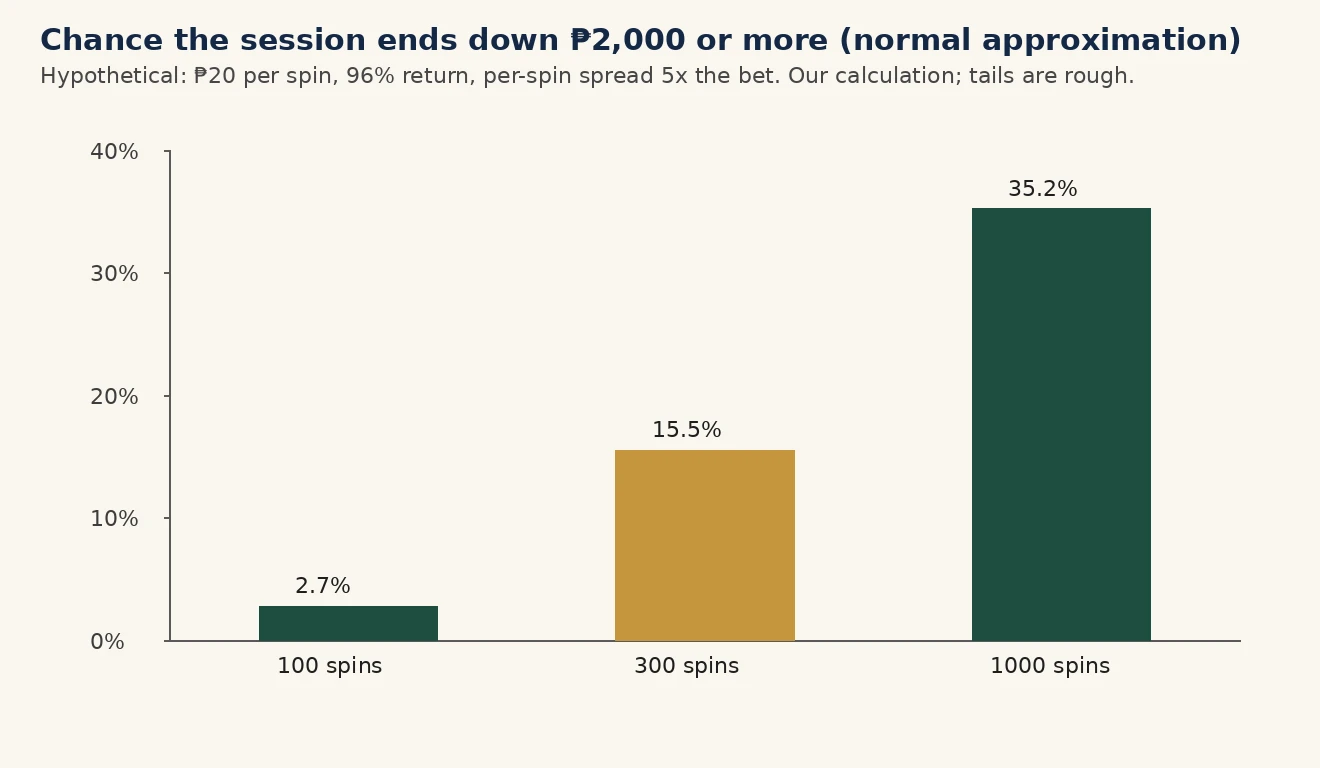
Read the table as a comparison, not a forecast. The 1,000-spin row does not mean a player will lose ₱2,000 in a third of sessions; it means that under these assumptions the end-of-session loss passes ₱2,000 in about a third of such sessions. The chance rises because the expected loss grows by ₱0.80 per spin and the spread grows with the square root of the number of spins.
Where the table understates the risk
- Ending versus touching. The table is about the balance at the end of the session. A session can fall below ₱2,000 at some point and recover. The chance of touching the loss limit at any time during the session is higher than the end-point chance shown here.
- Tails. The normal approximation is least reliable far from the mean. Real results with large wins and feature rounds have fatter tails than a normal curve.
- Feature buys and bet changes. Changing the bet, buying a feature or raising the stake mid-session changes the spread. The fixed ₱20 assumption then no longer applies.
Practical use
- Set the loss limit and the session length before you start, in pesos and in spins.
- Use your own game’s published RTP and a verified volatility figure, not the example spread used here.
- Treat a session that reaches the limit as the end of the session, not as a cue to keep betting to recover it.
What is verified and what is not
- Our calculation: the expected loss, spread and end-of-session chances in the table and chart, from the normal approximation with the stated inputs.
- Hypothetical: the ₱20 bet, the 96% return, the spread of five times the bet, and the ₱2,000 loss threshold.
- Not verified: the volatility, RTP or any feature behaviour of a real game. No provider or operator figure is used in this article.
The useful number is not only the expected loss. It is how quickly the chance of a large loss grows with session length, and that depends on inputs you should verify for your own game.